
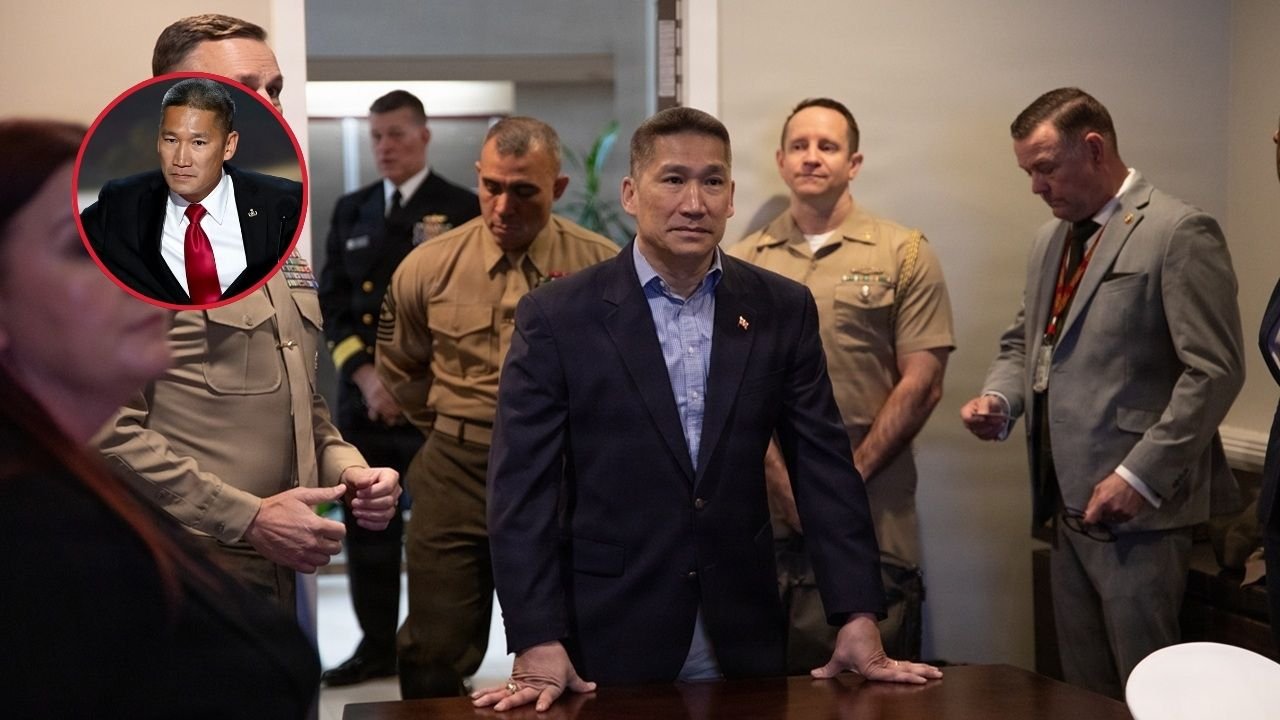
Hung Cao’s ethnicity and family background are an important part of the story behind his rise from a child refugee to one of the highest-ranking Vietnamese Americans in the United States military establishment.
Cao is Vietnamese American. He was born in Saigon, South Vietnam, in 1971 and left the country with his family in 1975 as South Vietnam collapsed at the end of the Vietnam War.
He was only four years old when his family began a journey that would eventually lead him to the United States, West Africa and later Virginia.
Decades afterward, Cao built a lengthy U.S. Navy career, became a political candidate in Virginia and entered senior civilian leadership at the Department of the Navy.
In April 2026, he became Acting Secretary of the Navy, bringing renewed attention to both his professional record and Vietnamese heritage.
What Is His Ethnicity?
Hung Cao is ethnically Vietnamese and identifies publicly as Vietnamese American.
His connection to Vietnam is not simply based on his family’s ancestry. Cao himself was born there and spent the earliest years of his life in South Vietnam.
During a return to Vietnam in June 2026, he spoke directly about his identity.
Cao said that he describes himself as an American while also recognizing that his roots and heritage are Vietnamese. The visit offered a particularly personal glimpse into how he views the two parts of his identity.
His Vietnamese background has remained significant even after more than five decades in the United States.
Born in Saigon
Cao was born in Saigon in 1971.
The city was then the capital of South Vietnam. It is known today as Ho Chi Minh City.
His early childhood unfolded during the final years of the Vietnam War, a conflict that would dramatically alter the future of his family.
In 1975, as communist forces took control of South Vietnam, Cao and his family fled the country.
He was four years old.
Official U.S. Navy biographies describe Cao as having immigrated to the United States in 1975. He has also described arriving through Guam as a Vietnamese refugee.
That refugee experience later became one of the defining themes of his public story.
A Refugee Childhood
Cao’s route to a permanent life in America was not entirely direct.
After immigrating to the United States, his family spent several years living in West Africa.
His father worked there as an agricultural specialist for the U.S. Agency for International Development.
The experience meant Cao’s childhood was spread across different countries and cultures.
He eventually returned to the United States and settled in Northern Virginia at approximately 12 years old.
Virginia would become central to his education, military career and later political ambitions.
Life in Virginia
Cao attended Thomas Jefferson High School for Science and Technology in Alexandria.
He was part of the prestigious school’s inaugural graduating class.
His path toward military service began shortly afterward.
Cao enlisted in the U.S. Navy as a seaman recruit in 1989 before eventually receiving an appointment to the United States Naval Academy in Annapolis.
He graduated from the Naval Academy in 1996 with a bachelor’s degree in ocean engineering and became a commissioned officer.
For a boy who had arrived in the United States as a refugee, it represented a remarkable change in circumstances.
Navy Career
Cao spent decades serving in the U.S. Navy.
He became a Navy diver and an explosive ordnance disposal officer and worked in special operations.
His assignments took him around the world.
According to his official Navy biography, Cao participated in multiple deployments to Iraq, Afghanistan and Somalia. He conducted underwater missions and worked on counter-improvised-threat operations supporting special warfare and special forces.
He also earned a master’s degree in applied physics from the Naval Postgraduate School and participated in programs connected with MIT and Harvard Kennedy School.
Cao retired from active duty in October 2021 with the rank of captain.
Vietnamese Language
Cao’s connection to his birthplace is also reflected in language.
The U.S. Navy lists him as fluent in both Vietnamese and French.
His multilingual background reflects the international nature of his childhood, which included his early years in Vietnam and time living in West Africa.
Cao has continued to speak publicly about Vietnam even as his identity and career became firmly rooted in the United States.
That combination became especially visible during his 2026 return to the country of his birth.
Return to Vietnam
In June 2026, Cao traveled to Vietnam in his capacity as Acting Secretary of the Navy.
The visit included participation in Pacific Partnership-Pacific Friendship 2026, a multinational program focused on areas including humanitarian assistance and disaster preparedness.
For Cao, however, returning to Vietnam carried a meaning beyond his official responsibilities.
He described the trip as personal because Vietnam was where his life began.
Speaking during the visit, Cao stressed that he considers himself American while remaining proud of his Vietnamese heritage. He described Vietnam as part of his roots and spoke about Vietnamese blood running through his veins.
The comments provided unusually direct confirmation of how Cao himself defines his ethnic and national identity.
Political Career
After retiring from active-duty military service, Cao became increasingly involved in American politics.
A Republican, he ran for Virginia’s 10th Congressional District in 2022 but lost to Democratic incumbent Jennifer Wexton.
He later challenged Democratic Senator Tim Kaine in Virginia’s 2024 U.S. Senate election.
Kaine won the race.
Although Cao did not win elected office, his military background and refugee story kept him visible in Republican politics.
His career subsequently shifted toward senior leadership within the Department of the Navy.
Navy Leadership
Cao was sworn in as Under Secretary of the Navy on October 3, 2025.
Another major promotion followed in 2026.
On April 22, Cao assumed responsibility as Acting Secretary of the Navy.
His appointment made his heritage particularly noteworthy.
In May 2026, U.S. Representative Derek Tran’s office described Cao as the highest-ranking Vietnamese American official in the U.S. Armed Forces.
The position placed someone who had fled Vietnam as a young child at the top level of civilian leadership overseeing the U.S. Navy and Marine Corps.
Wife and Children
Cao is married to April Lakata Cao.
The couple have five children, according to his official U.S. Navy biography.
Hung and April also co-authored the 2024 book Call Me an American: Refugee to Patriot: Lessons Learned for a Strong America.
The book explores Cao’s refugee journey, military service and views about the United States.
His family story has therefore become intertwined with the broader public narrative surrounding his Vietnamese origins and American life.
His Identity Today
For anyone searching for Hung Cao’s ethnicity, the clearest answer is that Hung Cao is Vietnamese American.
He was born in Saigon, South Vietnam, in 1971 and fled with his family in 1975. After spending part of his childhood in West Africa, he returned to the United States, grew up in Northern Virginia and ultimately spent more than three decades in the U.S. Navy.
His career has taken him from enlisted sailor to Navy captain and, eventually, Acting Secretary of the Navy.
Yet Cao has not presented that American journey as requiring him to erase his birthplace.
His 2026 visit to Vietnam made that particularly clear. More than 50 years after leaving as a refugee, Cao publicly embraced both sides of his story: his allegiance and life in America and the Vietnamese heritage that remains part of his identity.
