
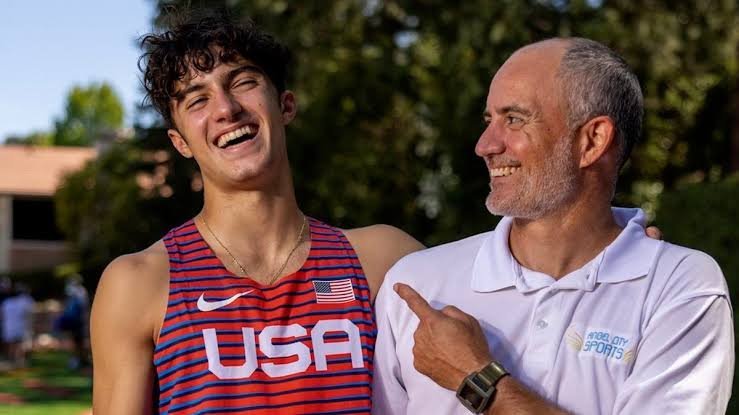
Ezra Frech has built an extraordinary sporting career at a young age, but the two-time Paralympic champion has never presented his success as a solo achievement.
His parents, Clayton Frech and Bahar Soomekh, have been central to his journey from a sports-loving child in Los Angeles to one of Team USA’s most recognizable Paralympians.
The family’s impact extends far beyond supporting Ezra from the stands. Clayton helped establish Angel City Sports after realizing that Southern California lacked enough adaptive sporting opportunities. Bahar, an actress with a successful Hollywood career, helped raise Ezra with an emphasis on confidence, purpose and giving back.
Their influence is particularly relevant in 2026 as Ezra, now 21, continues competing for USC while expanding his public profile ahead of the Los Angeles 2028 Paralympic Games.
Who Are His Parents?
Ezra Frech’s parents are Clayton Frech and Bahar Soomekh.
Team USA’s official athlete profile lists both by name and credits the family with playing an important role in the adaptive-sports community.
Ezra was born in Los Angeles on May 11, 2005.
He arrived with congenital limb differences, including the absence of his left knee and fibula and differences affecting his left hand.
His condition was unexpected for Clayton and Bahar.
Rather than allowing assumptions about disability to determine their son’s childhood, they encouraged him to participate in sports alongside other children.
That decision became fundamental to the athlete Ezra eventually became.
Father Clayton
Clayton Frech is much more than the father of a Paralympic champion.
He became a leading figure in creating adaptive sporting opportunities in Southern California after seeing firsthand how difficult those opportunities could be to find.
The turning point came in 2013.
Clayton took eight-year-old Ezra from California to Oklahoma for the Endeavor Games, an adaptive-sports competition.
Ezra entered a remarkable number of events, including track and field, archery, table tennis and sitting volleyball.
The trip was exciting, but it also left Clayton with a question: Why did his son need to travel so far simply to participate in high-quality adaptive sports?
That question changed the family’s direction.
Angel City Sports
Clayton and Ezra’s experience in Oklahoma helped inspire what became Angel City Sports.
The Los Angeles-based nonprofit provides adaptive sports training, equipment and competitive opportunities for children and adults with physical disabilities and visual impairments.
Angel City Sports says its origins date directly to the 2013 Endeavor Games trip involving Clayton and Ezra.
Clayton became the organization’s founder and has remained involved with its leadership.
The organization also developed the Angel City Games, which grew into a major adaptive-sports event.
What began as one father’s search for better opportunities for his son ultimately became a resource for an entire community.
Mother Bahar
Ezra’s mother, Bahar Soomekh, already had a public career before her son’s rise in Paralympic athletics.
She is an Iranian-born American actress.
Bahar was born in Tehran and moved to the United States with her family as a young child following the Iranian Revolution.
She later pursued acting and became known for several major Hollywood projects.
Her film credits include the Academy Award-winning Crash, as well as Mission: Impossible III and the horror movie Saw III.
Although audiences may recognize her from the screen, Ezra’s story has shown a different side of Bahar: the mother supporting a child whose ambitions quickly became unusually large.
A Difficult Beginning
Bahar has spoken candidly about the emotions surrounding Ezra’s birth.
She acknowledged that discovering her first child had significant limb differences came as a shock because the family had not expected it before he was born.
Yet the family quickly moved toward possibility rather than limitation.
Ezra received his first prosthetic leg when he was approximately 11 months old.
At age two, he underwent major procedures involving his left leg and hand.
As he grew older, sports became an increasingly important part of his life.
His parents did not isolate him from mainstream competition.
Instead, they placed him in activities with able-bodied children, including basketball, football, soccer, skateboarding, karate and surfing. U.S. Paralympics has credited that approach with helping Ezra build confidence and resilience.
Sports Everywhere
Ezra’s childhood was filled with competition.
Before becoming internationally famous for high jump, he played numerous sports and was particularly passionate about basketball.
His parents encouraged that enthusiasm rather than immediately steering him toward Para athletics.
The family’s approach allowed Ezra to think of himself as an athlete first.
Adaptive sports entered the picture alongside those mainstream experiences.
When Clayton took him to the Endeavor Games at eight, Ezra competed against other athletes with disabilities in a meaningful competitive environment.
Ezra later described that experience as something that changed his perspective.
Three years later, watching the 2016 Rio Paralympics gave him a much bigger dream: representing Team USA.
Two Gold Medals
That childhood ambition eventually became reality.
Ezra competed at the Tokyo Paralympics as a teenager, finishing fifth in the T63 high jump and eighth in the long jump.
His next Paralympic appearance changed everything.
At Paris 2024, Frech won gold in the men’s T63 100 meters with a personal-best time of 12.06 seconds.
He followed it by winning the T63 high jump, clearing 1.94 meters for a Paralympic record.
The two gold medals turned Ezra into one of the biggest American stars of the Paris Paralympics.
For Clayton and Bahar, the victories represented the culmination of years spent helping their son pursue sporting opportunities without allowing his disability to define what was possible.
His Brothers
Ezra is not Clayton and Bahar’s only child.
The couple have three sons, with Ezra being the oldest. His younger brothers are Gabriel and Elijah.
While Ezra’s international athletic career naturally attracts the most media attention, he has grown up as part of a close family unit.
His parents’ approach to raising him has also been connected to their wider values around community involvement.
That philosophy eventually helped transform what began as a personal family challenge into the work of Angel City Sports.
College Life
Family remained important when Ezra chose where to attend college.
He enrolled at the University of Southern California and joined the USC track and field program.
The move allowed him to compete at a major NCAA Division I program without leaving Los Angeles.
U.S. Paralympics reported that proximity to his family was among the factors he considered when making his college decision.
At USC, Ezra made history as the first above-the-knee amputee recruited to an NCAA Division I track and field program.
He is majoring in Business of Cinematic Arts.
LA28 Dream
The next enormous family milestone could arrive in their own hometown.
The 2028 Paralympic Games will be held in Los Angeles, giving Ezra the opportunity to compete for gold in front of family, friends and the adaptive-sports community that helped shape him.
It will also bring his journey unusually close to where it started.
Clayton once had to take his young son hundreds of miles away to Oklahoma simply to find the kind of adaptive competition they wanted.
Now Los Angeles is preparing to host the Paralympic Games themselves.
That transformation mirrors the work the Frech family has pursued through Angel City Sports.
Parents Behind His Success
For anyone searching for Ezra Frech’s parents, Clayton Frech and Bahar Soomekh are far more than names in an athlete biography.
Bahar brought her own experience as an Iranian-American actress and mother to a family that refused to define Ezra by physical limitations. Clayton turned the difficulty of finding adaptive competition into motivation to help build something that could serve thousands of other athletes.
Together, they encouraged Ezra to compete in mainstream sports, supported his Paralympic ambitions and helped create a community around adaptive athletics.
Team USA now lists Ezra as a two-time Paralympian, USC athlete and recipient of the 2025 Team USA Community Champions award.
Yet the family story started long before the medals.
It began with Clayton and Bahar deciding that their son’s limb differences would not determine the boundaries of his life. More than two decades later, that decision has helped shape not only a Paralympic champion, but a family-led movement that continues opening doors for other athletes with disabilities.
